Bibliography
Guillaume Faroult (ed.), Turner et ses peintres, exh. cat. Paris, Galeries nationales du Grand Palais, Paris, RMN, 2010, No. 5.
Jörg Zutter (ed.), Abraham-Louis-Rodolphe Ducros: un peintre suisse en Italie, exh. cat. Lausanne, Musée cantonal des Beaux-Arts, Milan, Skira, 1998, n° 27.
Pierre Chessex, A.L.R. Ducros (1748-1810). Paysages d’Italie à l’époque de Goethe, exh. cat. Lausanne, Musée cantonal des Beaux-Arts, Geneva, Editions du Tricorne, 1986, No. 51.

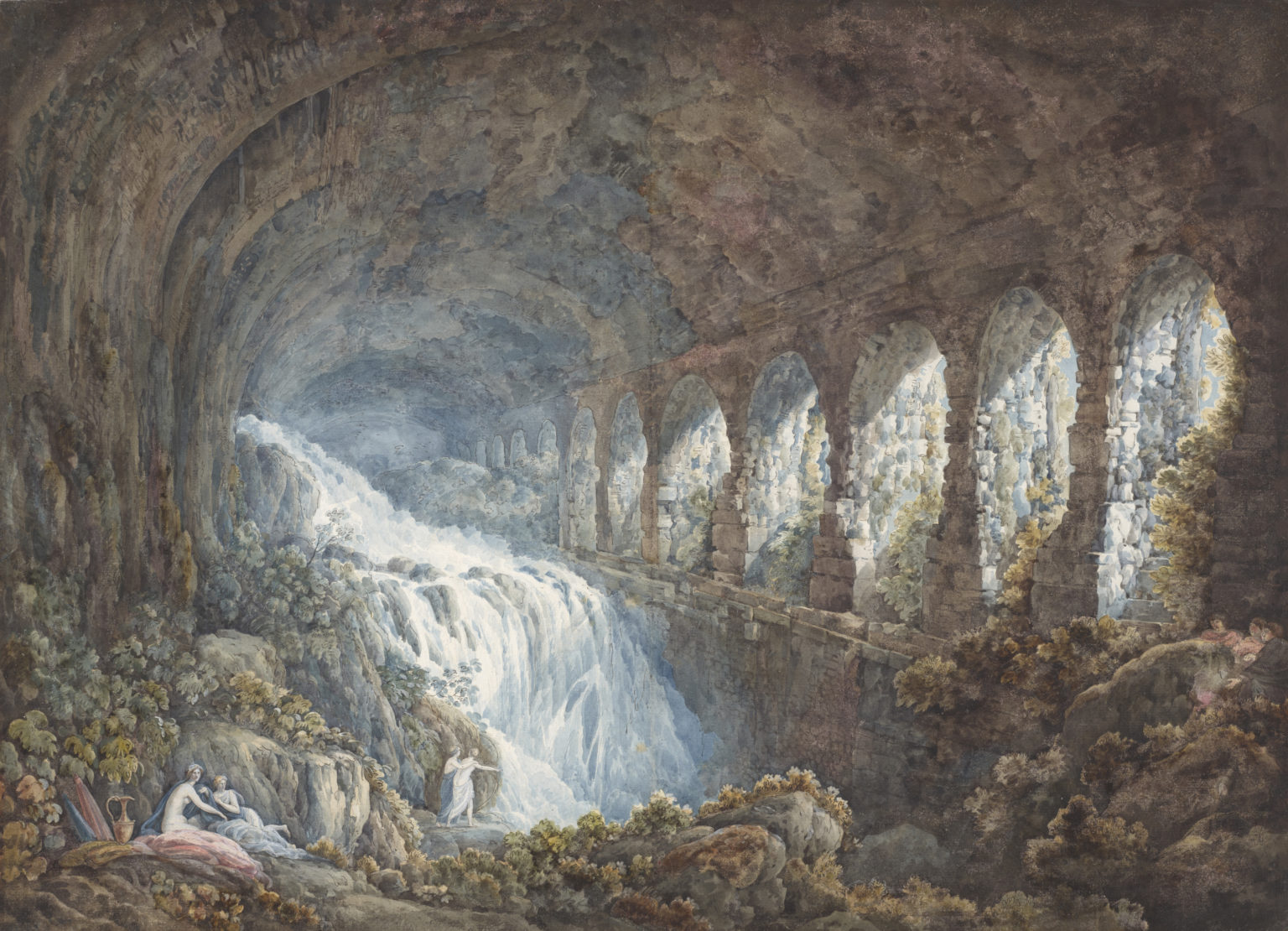
This watercolour takes viewers into what eighteenth-century visitors believed to be the ruined villa of Caius Maecenas in Tivoli. The site is in fact the ruins of the Sanctuary of Hercules Victor, dating from the second century BCE. Louis Ducros chose a diagonal, low-angle perspective to heighten the impression of a mysterious underground realm. The view is framed on the right by architectural remnants of Antiquity, half-shrouded by vegetation. The centre of the composition is flooded with light from two sources – one to the side, as the sun shines through the arches, the other more central, stemming from the roiling cascade. The foaming water takes its whiteness from the paper itself, left unpainted here. The wide angle and depth of field created by the torrent generate a sense of monumentality. The difference in scale between the dark, threatening, Piranesi-style vaults and the bathing women, spied on by visitors lurking in the foliage, sparks an air of erotic tension and brooding menace worthy of a Gothic novel.
Louis Ducros sold much of his work to English clients on the Grand Tour. One buyer was Sir Richard Colt Hoare, who purchased thirteen large vedute, including a version of this Interior of the Villa of Maecenas, Tivoli. It was on a visit to Colt Hoare’s stately home in Stourhead, Wiltshire, in around 1795 that J.M.W. Turner first encountered Ducros’s landscapes. They were to become a major source of inspiration, prompting him to experiment with large-format watercolours, adding gouache and varnish for a spectacular visual effect on a par with oils. Turner and Ducros are both heralds of Romanticism, depicting the sublimity of nature as a mirror of human emotions.