On display
The CollectionBibliography
Camille Lévêque-Claudet and Camille de Alencastro (ed.), Catalogue raisonné des peintures et des pastels français du Musée cantonal des Beaux-Arts de Lausanne 1800-1945, Lausanne, Musée cantonal des Beaux-Arts, 2025, cat. 30, p. 40-41.
Benedict Leca (ed.), The World is an Apple: The Still Lifes of Paul Cézanne, exh. cat. Hamilton (Ontario), Art Gallery of Hamilton, Philadelphia, The Barnes Foundation, Hamilton, Art Gallery of Hamilton, London, Giles Limited, 2014: 165.
Guillermo Solana, Cézanne site/non-site, exh. cat. Madrid, Museo Thyssen-Bornemisza, 2014: 130.

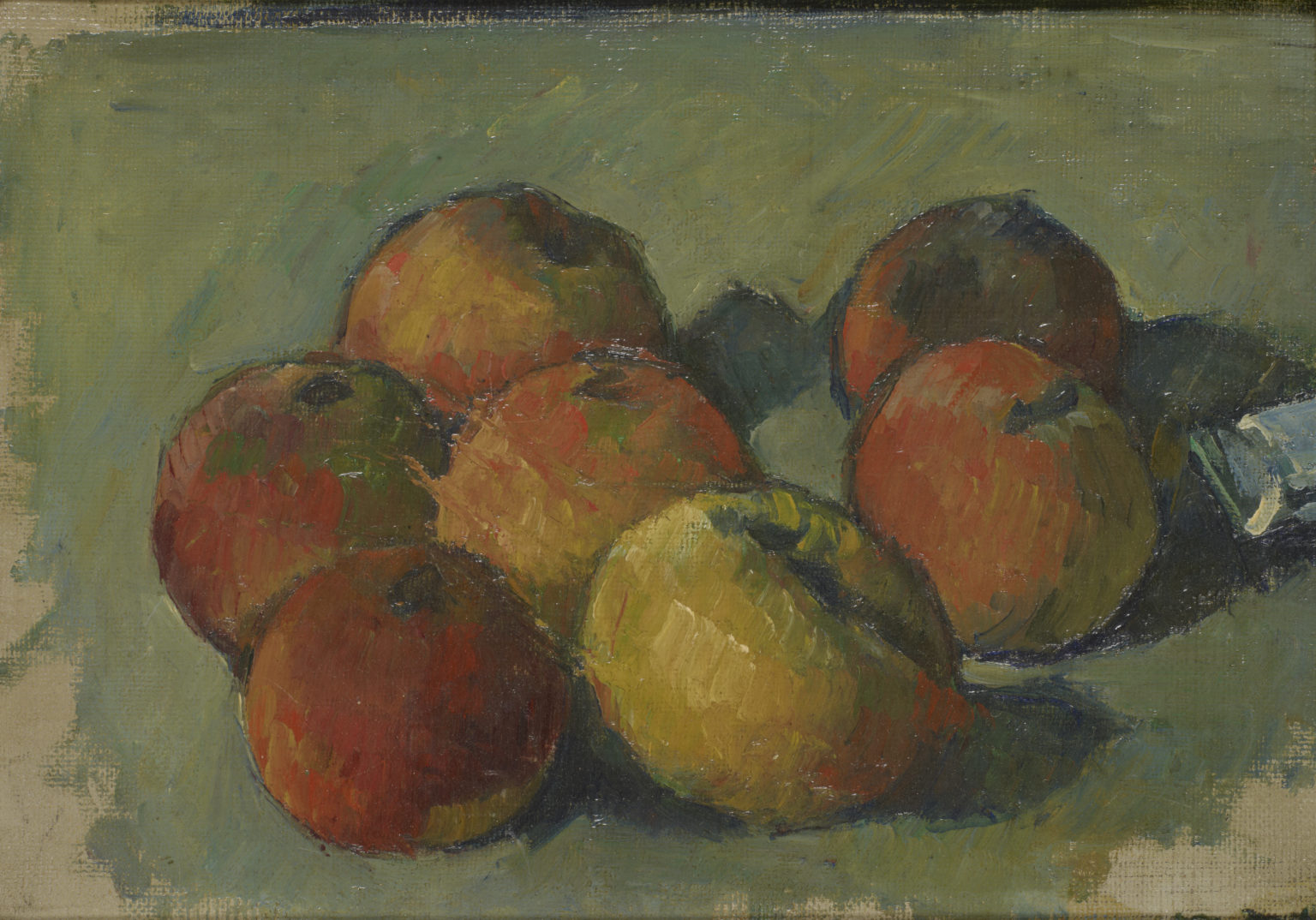
Paul Cezanne started using apples as the subject of his still lifes in the 1870s. Whether piled up in a fruit bowl, artfully spread over a tablecloth or, as here, shown on a table top, they became a familiar theme in his work. Indeed, this humble fruit served the artist as a medium for reassessing the fundamentals of academic painting and even conquering the French capital: his aim, he once said, was to ‘astonish Paris with an apple’.
Sept pommes et tube de couleur is one of those small canvases in which Cezanne concentrates on the fruit, analysing its colours and its appearance from every angle. Such works were like studies with which he practised his scales before going on to more ambitious compositions. A step towards cubism, this work was painted after Cezanne had emerged from his impressionist period but still shows what he had learnt about the analysis of light and cast shadow from the outdoor painting of Camille Pissarro. However, here concern with atmospheric effects gives way to formal and plastic considerations: the painter focuses on the arrangement of the objects, on the relations between them, on the handling of space and effects of light.
Cezanne, who criticized impressionism for its overly impulsive handling, produced a strongly structured composition. His brushstrokes are constructive, dense, precise and methodical. The apples, seven spheres isolated by a black outline, are given volume here by means of quick, slanting touches, simply by the modulation of colour, which makes them seem to swell from within. The white tube of paint breaks the warm harmony of the dominant complementary colours; the red of the apples and the ochre-green of the background. Cut off by the framing, this tube raises the question of what lies outside the painting. It is also, and above all, an anti-illusionist statement: these apples are in oil!