Marguerite Burnat-Provins Griche la borgne, Ma Ville (One-eyed Griche, My Town), 1915 Marguerite Burnat-Provins’s personality, like her artistic and literary work, encompassed two contradictory facets. She was born in Arras in northern France, married in…
Marguerite Burnat-Provins Le Criquet suivi de ses serviteurs portant des présents se rend au tombeau de ses ancêtres, Ma Ville (The Cricket, followed by his servants bearing gifts, approaches the tomb of his ancestors, My Town), March 1924 Marguerite Burnat-Provins was the eldest of eight children born to a cultivated family in the Pas-de-Calais. She began drawing at the age of…
Philippe Cognée Portrait d'un arbre indien 1 (Portrait of an Indian tree 1), 2011 This painting of a wooded landscape is typical of French artist Philippe Cognée's work. It reflects his deep appreciation for nature, his use…
Félix Vallotton Programme pour "Père" de Strindberg (Programme for Strindberg’s The Father), 1894 Félix Vallotton made his mark not only as a painter, but also as an illustrator, particularly in the decade from 1890 to 1900…
Gustave Buchet Paravent. Baigneuses au bord de l’eau (Screen. Bathers by the water), 1923 The spring of 1920 saw Gustave Buchet leave Geneva for Paris, where he was to spend the next twenty or so years. By…
Marius Borgeaud Intérieur aux deux verres (Interior with two glasses), 1923 Marius Borgeaud’s interiors are bathed in warm light that seems to bring time to a standstill. Each object is a solid, immediately identifiable…
Jacques Sablet Le Colin-maillard (Blind man’s buff), circa 1790 This painting was shown at the Paris Salon in year V of the French Revolution (i.e. 1796) and purchased in 1798 by Napoleon’s uncle Joseph…
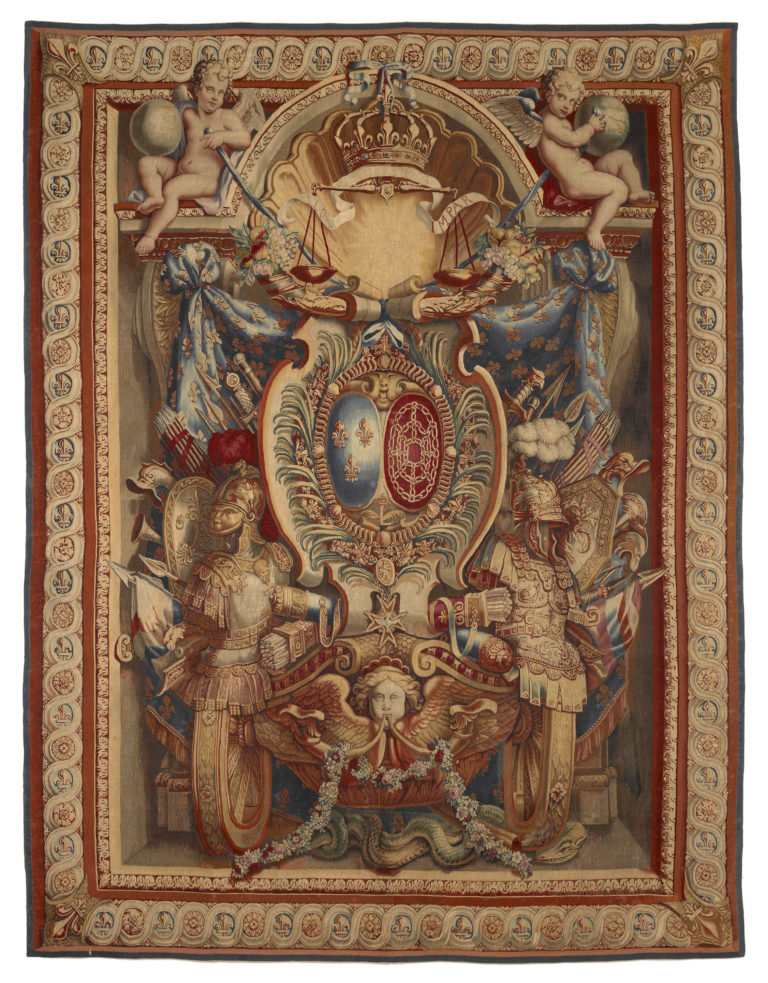
Manufacture des Gobelins, Paris Portière du Char de Triomphe (Portière of the Triumphal Chariot), late seventeenth century, Based on a design by Charles Le Brun, c. 1659-1665 This tapestry, made to hang over a door as a draught excluder, depicts a triumphal chariot face-on, showing the front of the carriage…
Ernest Biéler Les Tresseuses de paille (Women weaving straw), 1906-1907 Vaud-born Ernest Biéler first visited the Valais village of Savièse in 1884, moving there to settle in 1900. From 1906 on, he became…
Chavannes Alfred Paysage aux Ormonts (Ormonts landscape), between 1874 and 1894 Alfred Chavannes trained as an artist with Alexandre Calame in Geneva, then Oswald Achenbach in Düsseldorf. He returned to Switzerland in 1874, building…
Émile Claus Blackfriars Bridge (easterly breeze), 1919 Blackfriars Bridge spans the Thames a few hundred metres from what is now Tate Modern. The Belgian artist Émile Claus chose a view…
Théophile-Alexandre Steinlen Soulaud (Drunkard). Colour proofs for Le Mirliton, issue 123, 18 August 1893, 1893 Théophile-Alexandre Steinlen met the performers at the legendary Chat Noir cabaret soon after he came to Paris in the early 1880s, and soon became the…
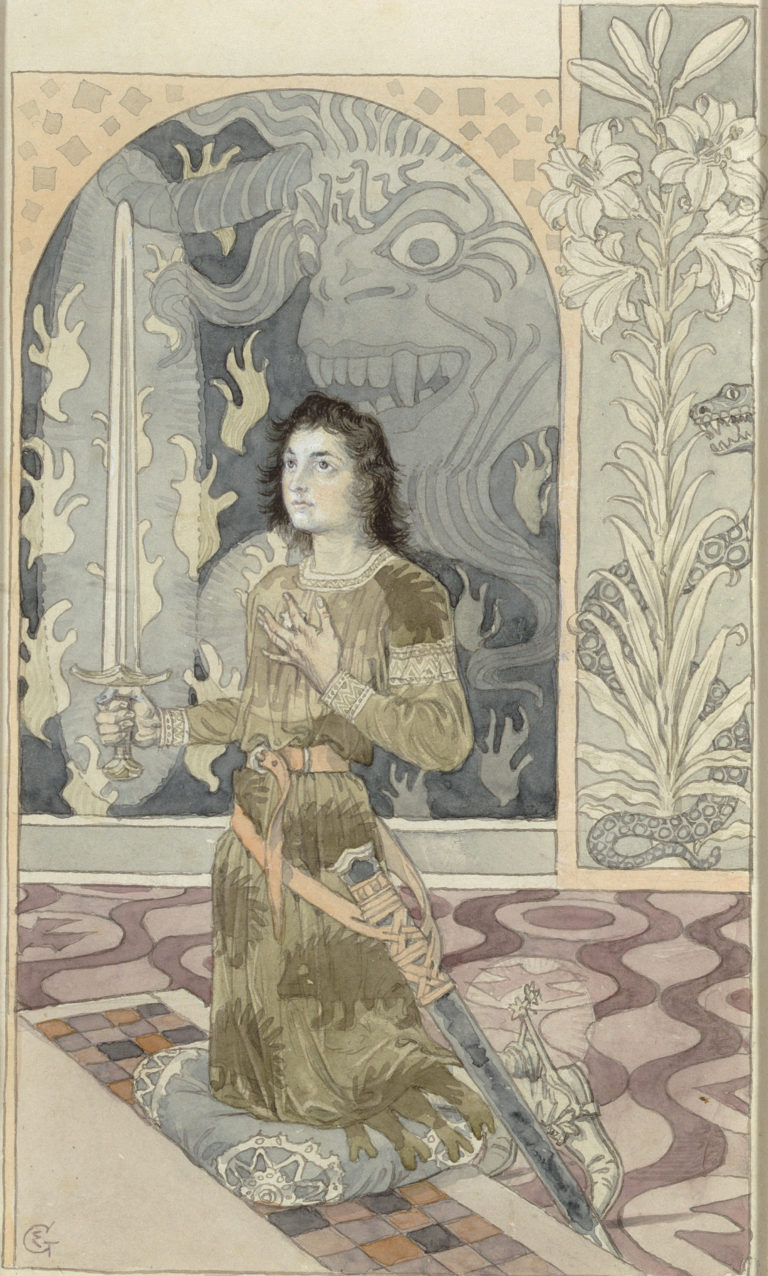
Eugène Grasset Le Saint Pleur. Adoubement du damoisel (Le Saint Pleur. Dubbing the young squire), 1891 Eugène Grasset’s career in illustration took off in 1883 with the publication of Histoire des Quatre Fils Aymon, much admired by book collectors for its…
Jean Clerc Portrait d’Élie Gagnebin (Portrait of Élie Gagnebin), 1931 Jean Clerc excelled at portraiture, and modelling proved the technique that suited him best. As the spiritual heir to Charles Despiau’s naturalism, but with a…
Édouard Vuillard Programme pour le théâtre de l'Œuvre (Programme for the Théâtre de l'Œuvre), 1894 The avant-garde Parisian Théâtre de l’Œuvre was established in 1893 by the actor Lugné-Poe, the writer Camille Mauclair and the artist Édouard Vuillard. All three…
Eugène Grasset La Sculpture (Sculpture), 1898 The June 1898 special issue of the avant-garde review La Plume was a homage to the sculptor Alexandre Falguière. The review held an exhibition of…
Charles Gleyre Portrait de Jean-Jacques Marquis (Portrait of Jean-Jacques Marquis), 1855 This portrait is painted in the realist tradition of bourgeois portraiture initiated by Jean-Auguste-Dominique Ingres and his Portrait of Monsieur Bertin (1832, now in the…
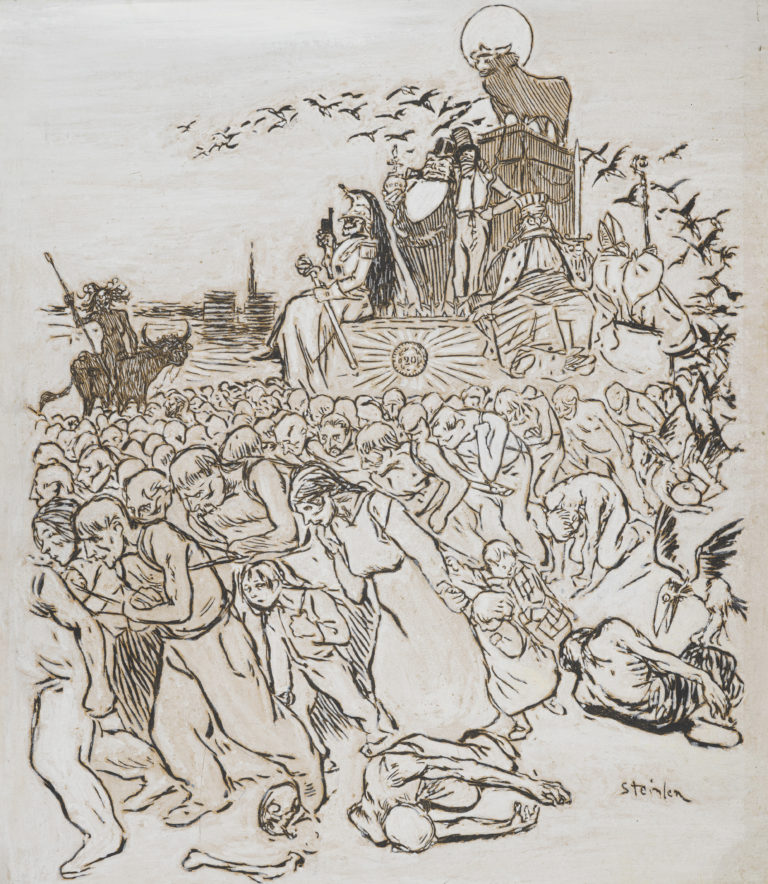
Théophile-Alexandre Steinlen Le Veau d'or (The Golden Calf), 1896 February 18, 1896, was the closing day of carnival, and the streets of Paris still rang with the noise of the riotous parade. To mark…
Giovanni Giacometti Portrait du Dr Henri-Auguste Widmer (Portrait of Dr Henri-Auguste Widmer), 1929 This portrait was acquired in 1994 to add to the set of seven Giacometti paintings bequeathed to the museum in the late 1930s by the…
Marius Borgeaud Bretonnes à la pharmacie (Breton women at the pharmacy), 1912 Marius Borgeaud spent the months from spring to autumn in the Breton village of Rochefort-en-Terre every year from 1909 to 1919. In 1911 and 1912,…
On display Félix Vallotton Stéphane Mallarmé, 1896 Around the turn of the twentieth century, Félix Vallotton produced some four hundred portraits of well-known subjects, mostly his contemporaries. The small Indian ink sketches…
Charles Édouard Rothenhaus La femme de Putiphar (Potiphar’s wife), 1880 The Book of Genesis recounts how Joseph, son of Jacob and Rachel, was sold into slavery in Egypt by his brothers. His new owner was…
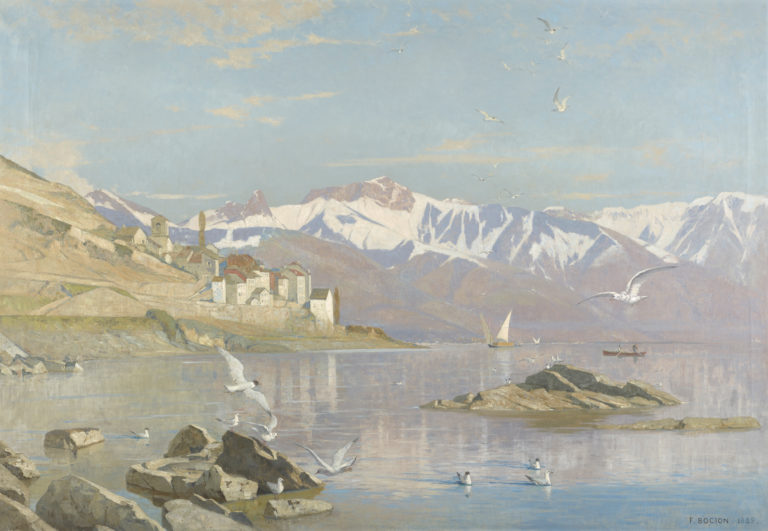
François Bocion Saint-Saphorin, 1889 This large painting depicts the village of Saint-Saphorin, recognisable from the unfinished church steeple. The brown tones of the stepped Lavaux vineyards and the Alpine…
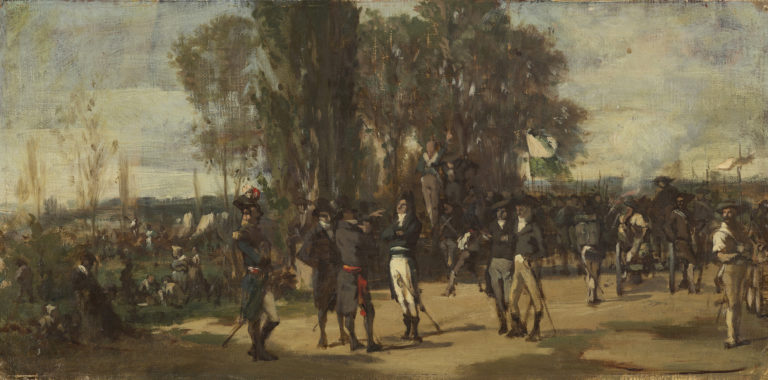
François Bocion Les Bourla-Papey (The Bourla-Papey Insurrection), undated François Bocion trained under Charles Gleyre in Paris, trying his hand at history painting on his return to Lausanne where he worked for the rest…
François Bocion, Jakob Lorenz Rüdisühli Le prêtre pêchant (Priest angling), 1868-1869 The painter and copperplate engraver Jakob Lorenz Rüdisühli moved to Basel in 1868. There, he set about popularising drawings by leading Swiss artists in several…
Jean-Pierre Saint-Ours Esquisse pour Les Mariages germains (Sketch for The Germanic Wedding), between 1784 and 1786 Jean-Pierre Saint-Ours, born in Geneva and trained in Paris, was awarded the Prix de Rome in 1780. However, as a Swiss Protestant, he was not…
Gabriel-Constant Vaucher La Mort de Socrate (The Death of Socrates), c. 1798 - 1799 Gabriel-Constant Vaucher, the son of an enamel painter, studied drawing in Geneva before moving to Rome where he trained with his cousin, the painter Jean-Pierre…