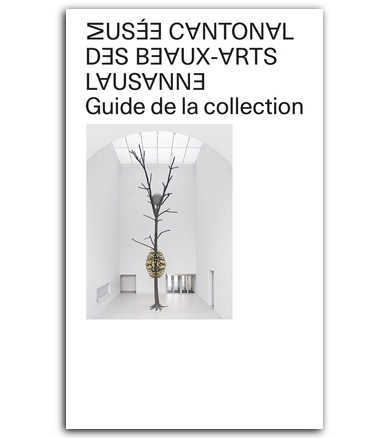
Visitors guide
The Collection
Visitors guide
The Collection
To see here what cannot be seen elsewhere! This is the guiding spirit behind this hanging of the MCBA’s collection. Since 1816, acquisitions, gifts, bequests and deposits have constantly enriched this collection. It allows visitors an opportunity to more fully appreciate the work of artists from the canton of Vaud and French‑speaking Switzerland more generally, whether they pursued their careers at home or abroad, and to compare and contrast it with international art trends.
The collection is especially strong in relation to movements such as Neo‑Classicism, Academicism, Realism, Symbolism and Post‑Impressionism; abstract painting in Europe and the U.S.; Swiss and international video art; New Figuration; Geometric Abstraction; and, in every period, the work of socially and politically engaged artists. It also comprises major monographic collections, including work by Charles Gleyre, Félix Vallotton,Théophile-Alexandre Steinlen, Pierre Soulages and Giuseppe Penone.
Installed on two levels, the selection from the permanent collection changes regularly, and pieces from the MCBA’s holdings are brought into dialogue with work on loan from private collections. In this way, our view of the astounding vitality of art as seen from Lausanne is always renewed.
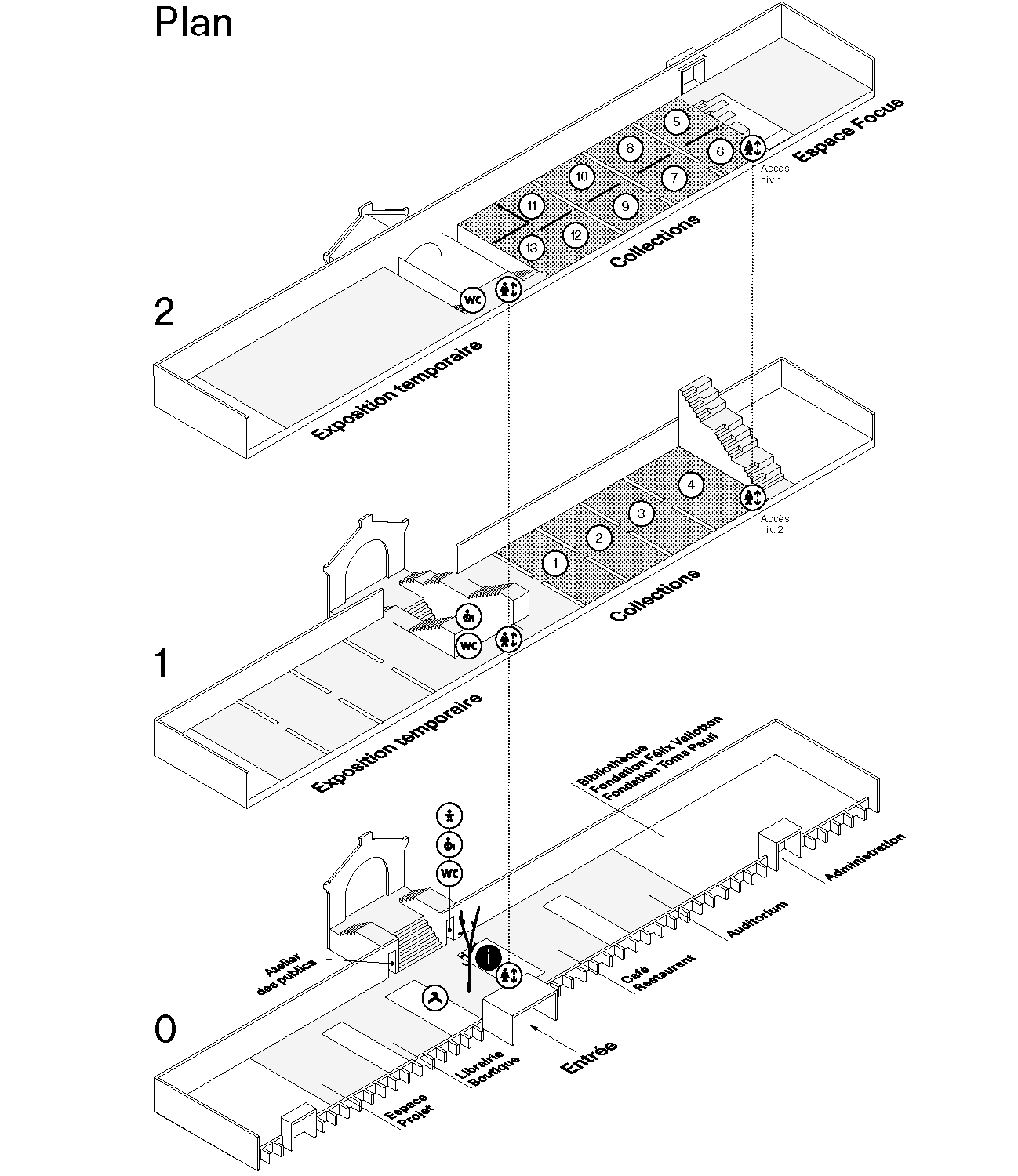
1st floor
Room 1
The road to modernity
The Bible and stories from classical antiquity
Starting in the 12th century, a new feeling arose in Europe foreshadowing the humanism of the Renaissance. From this time on painters and sculptors would place humankind at the centre of the world. The Bible and the apocryphal gospels remained a major source of inspiration. Episodes from the childhoods of Mary and Jesus lent themselves to more realistic treatments of scenes showing daily life (FRANCESCO DA RIMINI, CERCLE DE QUENTIN METSYS). Landscape painting and architecture were informed by on‑site observations, sometimes incorporating elements imitating ancient Greece, Rome and the Middle East (CIRCLE OF PIETER COECKE VAN AELST). During the Baroque period, the Old Testament inspired ambitious compositions executed in large formats; in the late 17th century in Southern Europe, the Neapolitan School, working in the wake of Caravaggio, deployed chiaroscuro effects to dramatise great moral subjects (LUCA GIORDANO). In Northern Europe, the warrior epics of ancient history inspired Flemish tapestry.
Italy and the East
In the late 18th century, many Swiss artists emigrated to Paris or Italy. JACQUES SABLET settled permanently in Rome. Ineligible for religious art commissions, which were reserved for Catholic artists, he specialised in open‑air group portraits and scenes from daily life.
A generation later, CHARLES GLEYRE, who had studied art in Paris and spent some time in Rome, set out East on a long journey that would take him from Greece to Nubia. Back in Paris he devoted himself to classically inspired history painting, blazing a singular path between Romantic passion and academic rigour.
Landscapes
Beginning in the late 18th century, landscape painting became a medium for expressing a weather‑focused sensibility that visually translated the feeling of insecurity accompanying the years of the French Revolution and Napoleonic wars. Catastrophe painting, with its storms and erupting volcanoes, as well as its vast desolate lands, bodied forth the loneliness of human beings and the sublime grandeur of nature (LOUIS DUCROS, CHARLES GLEYRE).
Modern history
The two French‑speaking Swiss painters FRANÇOIS SABLET et JEAN‑PIERRE SAINT‑OURS trained in Paris in the studio of the painter Joseph‑Marie Vien. Both men embraced Neoclassicism, a movement at the turn of the 19th century that arose in reaction to the excesses of the Baroque and Rococo. Inspired by the simplicity and rigour of the arts in ancient Greece and Rome, they refined their style. Thus, outlines became firm, line pure, and colours quite bold.
Their subjects sing the praises of the great ethical principles that were supposed to govern citizens’ private lives for evermore, such as the solemnity of marriage and the dignity of mourning. The family as a unit was celebrated for its resilience before the up-heavals of the times, symbolised by natural disasters.
Room 2
The triumph of realism
During the 19th century, Switzerland went through a step‑by‑step process that transformed it into a unified federal state. Since the country lacked a centralized art education system and a dynamic market, its artists often went abroad. Their unique qualities flourished in landscape and genre painting. Geneva’s FRANÇOIS DIDAY and ALEXANDRE CALAME were the founders of a truly Swiss art featuring its emblematic landscapes. Diday portrayed Alpine peaks, with a monumental and sublime vision still strongly infused with Romanticism. His student Calame, influenced by 17th‑century Dutch painting, preferred middle altitude views. The triumph of realism in the second half of the 19th century, from Naturalism to Impressionism, allowed Swiss artists to shine at the Paris Salon. Their work tended to represent the traditions and customs of people living far from big cities, spared from the Industrial Revolution that dissolved traditional communities of farmers and craftsmen. EUGÈNE BURNAND and ERNST BIÉLER did animal painting and genre scenes in monumental formats previously reserved for history painting. FRÉDÉRIC ROUGE and ALBERT ANKER painted portraits of social and professional archetypes, while also looking to the world of children for inspiration. A proponent of atmospheric plein‑air painting, FRANÇOIS BOCION took Lake Geneva as his main subject, tirelessly recording the play of sunlight on the water and the passing clouds above. After finishing his art studies in Paris, he spent the rest of his days in his native Lausanne, where he cultivated a local clientele. In the field of portraiture, Impressionism and Art Nouveau invited painters to represent quiet moments in natural surroundings or bourgeois drawing rooms. The act of painting became a moment of truth free from social conventions. Models were seen in informal poses, at rest or carrying out leisure activities and other daily pursuits (LOUISE BRESLAU, ERNST BIÉLER, CHARLES GIRON). Like the Belgian sculptor CONSTANTIN MEUNIER who realistically portrayed men labouring under harsh conditions, French-Swiss THÉOPHILE-ALEXANDRE STEINLEN put his art at the service of his political convictions and his commitment to the struggle against social injustice. Making Montmartre his home, he chronicled the days and nights of the Parisian lower classes whose voice he became.
Room 3
Art in France, from realism to Post-Impressionism
The creation of Orientalist imagery played a significant role in constructing a colonialist ideology, with art and artists, so to speak, bringing up the rear of France’s military expeditions in Africa. JEAN-LÉON GÉRÔME, for instance, contributed his share to the mania for all things Egyptian that spread throughout the 19th century. He would prove an inexhaustible source of landscapes, views of ancient monuments, and genre scenes. CHARLES ÉDOUARD ROTHENHAUS, his student at the École des Beaux-Arts in Paris, inherited Gérôme’s theatrical approach to stories drawn from the Bible and history. Working in the service of the Second Empire, HORACE VERNET embodied the alliance of art, the Church, and the French Army.
In contrast, far from the vogue for painting exotic locales and lives, many artists explored the French homeland, the nation’s own territory. In the early 19th century, a new generation freed landscape painting from academicism, the approach taught in art schools. Until that time studies from nature – exercises in observing the world outside the studio – had never been intended to vie with carefully composed landscapes or to hang in the Salons.
JEAN-BAPTISTE CAMILLE COROT was one of the first to make plein-air painting respectable and worthy of the patron’s favour and the public’s attention. Starting in the 1820s in the Fontainebleau woodlands, he worked to promote the concepts of spontaneity and quick execution, the freshness of the medium and the individuality of sensory experience. After 1848 Barbizon became a stopping-off point and gathering place of painters who had fondly embraced this ‘realist’ approach. Paying close attention to the contrasting textures of their pigments and light effects, they saw nature as an event in itself (NARCISSE DÍAZ DE LA PEÑA). GUSTAVE COURBET focused on motifs that express a feeling of life’s fragility in the same way a vivid scene could.
In the early 1860s, genres once considered minor became the favourite breeding grounds of the revolutions that changed pictorial modernity. Such was the case with still life painting. While some artists continued to uphold the tradition (AUGUSTIN THÉODULE RIBOT), others took up the medium to write a new chapter in art history and the freeing up of form and colour to render them independent of strict realistic representation (PAUL CEZANNE, HENRI MATISSE). Likewise, landscape painting continued to evolve towards an ever more forthright expressiveness in capturing fleeting sensations, a core concern of the Impressionists. (CLAUDE MONET in Normandy, AUGUSTE RENOIR in the South of France). In the Nabis’s case, landscape painting reconnected with a vocabulary that is musical, decorative and ornamental (KER-XAVIER ROUSSEL, MAURICE DENIS).
Room 4
Figurative art, from Auguste Rodin to Alberto Giacometti
In the second half of the 19th century, AUGUSTE RODIN was the most remarkable champion of an approach to sculpture that was rapidly changing, between the classical tradition until then and modernity. For Rodin, a piece’s resemblance to the model had to be both physical and moral. His heirs, like ÉMILE-ANTOINE BOURDELLE, went a step further in expressiveness, working with notches, crevices, and mutilations; they integrated the pedestal or base into the overall design of the work’s volumes.
In the mid-1920s, ALBERTO GIACOMETTI distanced himself from Rodin’s legacy and what Bourdelle had taught him. He studied Cycladic and Egyptian art, discovered the art of Africa, Mexico and Oceania, and tapped into the principles of Cubism and later Surrealism. Concentrating on analysing his view alone, he pushed his decomposing and paring down of bodies to the limit.
In Geneva in late 1941, Giacometti renewed contact with BALTHUS, whom he had met in Paris in the 1930s. During the War and the following decade, many other artists who, like them, strongly felt the need to get back to what is human, rejected Abstraction and questioned once again figuration in the context of existentialism. In his portraits, Balthus explored a personal aesthetic based on effects achieved through disproportion, unusual poses, and formal simplifications.
A feeling of unease comes from the rigidity of the body’s position and the emptiness in the eyes that Balthus lends his subjects. That malaise is seen in the paintings done during the War by FRANCIS GRUBER, who took the hard reality of both the period and the human condition and translated it into cold light, gaunt bodies frozen in place, and oppressive spaces. At the same time, Giacometti was finding that capturing the physical and psychological traits of his subjects was a goal that could never be reached. Bringing sculpture down from its pedestal, he interrogated its connection with the viewer and space.
Slender or massive but always frontal in appearance, his figures seem like blocks of magma, shredded, kneaded, and gouged out. Looking for a new kind of figuration, JEAN DUBUFFET turned to simplifying his means to the extreme, opting for the rough line and clumsy unrefined drawing he admired in the work of self-taught artists. He, too, pursued a physical confrontation with paint, covering the canvas with thick pasty layers of putty-like pigments. In his landscapes, he was, like Balthus, searching for the ‘wall effect’ of fresco painting. ZAO WOU-KI arrived in Paris in 1948 and was to count Giacometti amongst the friends who provided him with support in his formalist search. Opting for lyrical abstraction as the way forward, he reconciled his cultural Chinese background with Western modernity, reconnecting with primordial gestures in large dynamic compositions.
2nd floor
Room 5
A more figural abstraction: the 1950s
The postwar period in both France and the United States saw new trends in abstract art quite different than the geometric approach of abstractionist pioneers such as Kasimir Malevitch, František Kupka, Piet Mondrian and Sonia Delaunay. Various labels such as “Lyrical Abstraction” and “Abstract Expressionism” were put forward, but none of them successfully embraced the diversity of these artists. For example, in Paris, MARIA HELENA VIEIRA DA SILVA made allusive paintings whose fragmented compositions sometimes suggested architectural forms, while PIERRE SOULAGES explored the effects of textures and light using a variety of tools, raw materials and supports. Europe also attracted American painters. In Italy, CY TWOMBLY developed an intimate and erudite abstraction steeped in references to antiquity. In Paris, BEAUFORD DELANEY was experimenting with the possibilities of a queer abstraction, both fluid and luminous. The impetus of the creative project itself finds expression in the freedom of the artist’s gesture, which goes as far as saturating the pictorial space, as KIMBER SMITH’s painting testifies.
Room 6
Escape from the canvas: 1960s – 1970s
In the late 1960s, the social revolution sweeping throughout Western Europe erupted in art‑making as well. Artists were eager to cast off the weight of tradition. Painting was the first medium to undergo this transformation as Pop Art made consumer society its subject, using vivid colours and slogans evoking the advertising signs per‑ meating the urban environment (JANNIS KOUNELLIS, ÉMILIENNE FARNY). In Paris, the Nouveau Réalisme artists (DANIEL SPOERRI, DIETER ROTH) embedded real‑life objects in their work. Others, inspired by the Fluxus movement, erased the boundaries between life and art. With a touch of humour, they absorbed everyday routines, images and objects into their work and appropriated industrial materials such as neon, phosphorous and plastic (TADEUSZ KANTOR, JANOS URBAN).
Video art emerged as a medium for visual and all sorts of experimentation as some artists turned their own bodies into a political statement (VALIE EXPORT), while others experimented with the medium itself (JEAN OTTH, NAM JUNE PAIK).
Room 7
Spaces of the body: 1980s
During the 1980s a new trend in painting and sculpture arose, a counter current to the austerity of the minimalist and conceptualist mouvements of the preceding decade. Neo Expressionism, instead, drew inspiration from earlier twentieth century art. Its avatars in Germany and Austria were the Neue Wilde (New Fauves); in Italy, the Transavanguardia; in the U.S., the Bad Painting artists. Called “figuration libre” in France, and appearing in Switzerland as well, this rough but often euphoric art was the product of a determined, violent attack on a surface, grappling with a quickly emerging image. Drawing and painting lost their distinctive attributes. Charcoal, ink, watercolours and acrylics were applied directly, often on paper, with no preliminary sketch, as in the work of MIRIAM CAHN, GÜNTER BRUS, and BIRGIT JÜRGENSSEN. The sheet of paper shows signs of the artists at work (crinkles and folds), their entire body engaged in an intense and immediate moment of creation. Although the body or a trace of it is clearly present, other artists make use of an altogether personal mythology to signify it. HÉLÈNE DELPRAT, for example, adopts a type of figuration that references totemic forms in her pictures from the 1980s, while ALBERT OEHLEN reappropriated motifs that are full of associations in a gestural painting that rejects any and all technical constraints.
Room 8
Abstractions
Once they are stripped of all reference to the exterior world, paintings are no longer about anything but their own forms and materiality. This is what OLIVIER MOSSET, in 1969, called “the degree zero of painting.” The absence of events is manifest in his large red monochrome done twenty years later. JOHN M ARMLEDER, associated with the Neo‑Geo movement, made what he called “furniture sculptures,” a droll reminder that the purpose of artworks is to decorate living rooms. The thinking of these two artists about the renewal of abstractionism encouraged a strong interest in geometric abstraction in the Lake Geneva region, beginning in the 1980s and continuing today. Instead of bearing the artist’s signature touch, the canvas is covered with a uniform application of paint; subjectivity, neutralized by geometrical forms, is evident almost only in the formal choices. While some artists allude to personal stories in their work (JEAN-LUC MANZ), others stick to a pre‑established protocol (CLAUDIA COMTE) or explore the painting as an object and the sculptural qualities of the surface (PIERRE KELLER).
Rooms 9 –10
Reclaiming the stage
Throughout history, many artistic positions have been marginalised or rendered invisible. This is particularly true of queer practices, which draw their political significance and aesthetic strength from the history of non‑normative communities, without constituting a stable, fixed category. On the contrary, by refusing to promote a normative system marked by binarity, the artists brought together in these rooms place the fluctuating and multifaceted nature of our identities at the heart of their thinking. Beyond their diversity, these forms of expressions are united by the same drive to regain visibility.
Often incorporating elements from the world of design, TOM BURR’s work focuses on the erosion of public areas and our status as viewers before a fantasised space. The two platforms look like theatrical spaces that are free of (re)presentations and demonstrations, like a set waiting to be activated. Humorously reappropriating the trompe‑l’oeil technique by including fragments of the body, SARAH MARGNETTI questions the political dimension of the domestic sphere and its architecture. The complex dynamics that exist between the individual and the collective, the private and the public, interior and exterior are at the heart of these strategies of visibility. Pierre Keller’s work in photography captures from life the erotic odyssey of the gay scene in the 1980s, which was marked by its underground reality. In contrast, fascinated by the mechanisms of celebrity and the images it generates, NINA CHILDRESS immortalises the androgynous figure of Swiss singer Patrick Juvet in a defiant pose that suggests self‑affirmation. Parodying the biopic genre, the performative element also gives substance to GUILLAUME PILET’s series of autobiographical drawings.
Finally, the practice of PAULINE BOUDRY / RENATE LORENZ is based on a “queer archaeology” that revives forgotten drag figures by superimposing images. The film Normal Work is inspired by archival photographs taken in England in the 1860s by Hannah Cullwick, who worked her entire life as a servant. She is seen posing in her work clothes but also in “class drag” and “ethnic drag”, that is, dressing up as a bourgeoise or a black enslaved woman. Re‑enacted by the performer Werner Hirsch, this gesture raises the question of crossing boundaries laid down by social norms and, to borrow the title of a book by the philosopher Judith Butler, of the visibility of “bodies that matter”.
Rooms 11+13
Words and images
The title of these two rooms comes from René Magritte, who described in a 1929 text titled “Les mots et les images” the poetic use to which he was putting objects and their names in his work. Almost a century later, this turn of phrase by the Surrealist painter invites us to discover the diversity of formal vocabularies artists have developed over time. The works on view here represent a few of them, both suggesting words that translate thoughts and playing with perceptual illusions that alter and transmute forms and meanings. As an introduction, visitors pass through RENÉE GREEN’s Space Poem that is made up of coloured flags sporting lines of a poem written by Laura Riding in the 1930s. In the work of CHÉRIF and SILVIE DEFRAOUI, writing is cut horizontally to become both sign and decoration. Certitudes arise and then crumble in MARKUS RAETZ’s anamorphoses, a distortion also found in the works of GIUSEPPE PENONE, who analyses the mysteries of vision and its representation.
Room 12
Monuments
In 1982, Maya Lin, then an undergraduate architecture student at Yale, won a competition for the design of the Vietnam Veterans Memorial, black marble walls like notches in the earth, an explicit counterpoint to the triumphal verticalism and whiteness of Washington statuary. Since then, many artists have transcribed the complexity of memory processes and their representation by making anti‑monuments that emphasize absence, void and loss rather than a unifying narrative. Examples in this case include the Monument Against Fascism by Esther Shalev‑Gerz and Jochen Gerz (Hamburg Harburg, 1986‑93) and Rachel Whiteread’s Holocaust Memorial (Vienna, 2000), but also works made for the museum rather than for a particular public space. Alfredo Jaar’s Real Pictures (1995‑2007) in the MCBA collection, and Gurbet’s Diary by BANU CENNETOĞLU come to mind, and in a more dystopian vein, JULIAN CHARRIÈRE’s Pacific Fiction – Study for a Monument. In their way, all these works are part of an anti‑monument approach to memorialisation while making plain the difficulty of lending concrete form to both the commemoration of violence and the great tragedies of history. In ADRIAN PACI’s film The Column, shown in the adjacent room, it is the very material of monuments, and their displacement in a globalized economy, that take center stage.