Exhibition guide
Otobong Nkanga. I dreamt of you in colours
Introduction
A major figure on the contemporary art scene, Otobong Nkanga, born in Kano, Nigeria, in 1974, and based today in Antwerp, Belgium, has been developing a body of work that draws inspiration from her history and research, focusing on the connections between ecology, memory and the circulation of resources.
Following her studies in Nigeria, France, and the Netherlands, the artist explored issues relating to mining and the use of the earth’s resources, examining our complex social, political and material connections to space and the earth through a multidisciplinary practice including drawings, paintings, installations, tapestries, photographs, videos, sculptures, ceramics, performances, sound and poetry.
Drawing on her personal history and research, which reflects transhistorical and diverse influences, she creates networks and constellations between humans and landscapes while addressing the restorative capacity of natural and relational systems.
The notion of strata is central to the artist’s practice, both in the materiality of her works and in her way of thinking about the relationships between bodies and lands, made of mutual exchange and transformation. Nkanga simultaneously explores the circulation of materials and goods, of people and their intertwined histories, as well as their exploitation, marked by the residues of violent colonial histories. While questioning memory, she offers the vision of a possible future.
At once a survey and a cross-section of the artist’s protean oeuvre, the exhibition traces the genealogy of recurrent subjects whose visual expression is constantly evolving. It brings together emblematic installations, monumental tapestries, and a significant number of drawings, some of which go back to the earliest years of her career and are being shown for the first time. On this occasion, the artist reactivates certain works through performances in a poetics of entanglement, creating connections between forms, materials, and ideas.
1st Floor
Gallery 1
The exhibition opens with works on paper created while Nkanga was still a student at the Fine Arts Department at Obafemi-Awolowo University in Ilé-If, Nigeria. In her first year at the University, Nkanga studied mainly painting and in particular the colour palette whose chromatic range runs throughout her work, and which would later unfold in the shimmering hues of her monumental tapestries.
It was in Paris, where she was studying at the École des Beaux-Arts, that Nkanga created what she considers to be her first-complex and multi-layered work of art, Fattening Room (1999). In this piece she brought together for the first time her ideas on architecture, sculpture, and costume design in a performance that gave rise to a photomontage. This work thus encapsulates the central themes that the artist would continue to explore, namely the body in its connection to the earth, architecture and textiles, at the crossroads of multiple influences.
The artist’s relationship to home and child-hood memories can be seen in the drawing series Filtered Memories (1999), in which she revisits significant events from her early years. As she puts it, emphasising the importance of drawing in her practice, ‘From childhood, apart from play-ing with the soil, I was also drawing and sketching things… Drawing is that space of release where thoughts, imaginaries, conflict, anger, all kinds of emotions and feelings are put together and bundled and thrown out onto the paper. But it’s also a way for throwing out sketches and plans, because only by drawing can I get close to what I wish to convey.’
The installations Awaiting Pleasures But It Cut (2002–2003) and Awaiting Pleasures – The Workstation (2003) reflect her connection with architecture and her taste for experimentation. The needle, an element found at the heart of both installations, bears a dual meaning, between care and threat, tackling the question of the body and its vulnerability. These wooden structures, like the ceramic pieces in Pleasure Fragments (2002), were created mainly for performances.
With the Alterscape (2006) series of photographs, the artist pictures herself behind a model where natural landscapes and human constructions blend. She seems to physically merge with the environment, inviting us to think about our human impact on the Earth, but also about our potential for connection with the landscapes and biodiversity that surround us.
Gallery 2
L’installation In Pursuit of Bling (2014) présentée dans cette salle restitue une recherche menée par Nkanga sur une ancienne mine de cuivre à Tsumeb, en Namibie, et rend compte des métamorphoses des ressources naturelles lors de leur transformation de matières premières en produit fini. Tsumeb fait partie d’un système extractiviste dans lequel une localité riche en ressources est saisie et expropriée pour être intégrée dans un réseau mondial de capitaux et d’infrastructures. Entre le début de son exploitation en 1875 et la fermeture de la mine en 1996, des millions de tonnes de cuivre, zinc, plomb, cadmium, argent et germanium ont ainsi été expédiées vers l’Allemagne, la Belgique et l’Amérique du Nord, laissant une terre épuisée et vidée de ses ressources.
Initialement créé pour la 8e Biennale de Berlin après un long processus de recherche, In Pursuit of Bling est composée de minéraux (mica, malachite, cuivre), d’images photographiques imprimées sur du calcaire, de poudre de maquillage, et de vidéos présentées dans un dispositif de 28 tables placées autour de deux tapisseries qui re-produisent la structure d’un atome minéral. Le tout constitue une cartographie des lieux d’extraction de minéraux brillants (bling), de leur circulation et de leur transformation, et souligne les liens entre entreprise coloniale, pouvoir et ressources naturelles.
Dans la vidéo Remains of the Green Hill (2015), réalisée à Tsumeb, Nkanga s’adresse à la terre blessée en chantant, prenant acte de toutes les ressources pillées à cet endroit, et du coût en vies humaines et non humaines. Elle parle de sa performance comme d’un acte d’apaisement, semblable à une offrande à la terre.
En face de l’installation, la tapisserie The Weight of Scars (2015) explore elle aussi les paysages meurtris, la question de la reconstruction et le poids des héritages coloniaux et extractivistes. Les photographies circulaires aimantées sur la tapisserie documentent les vestiges de divers sites miniers abandonnés de Namibie: sol fissuré, béton négligé, pipelines et espaces vides clôturés. S’appuyant sur l’effet que les images ont sur notre perception du monde, l’artiste établit un état des lieux des activités industrielles et de leurs conséquences aussi bien géologiques qu’humaines.
Gallery 3
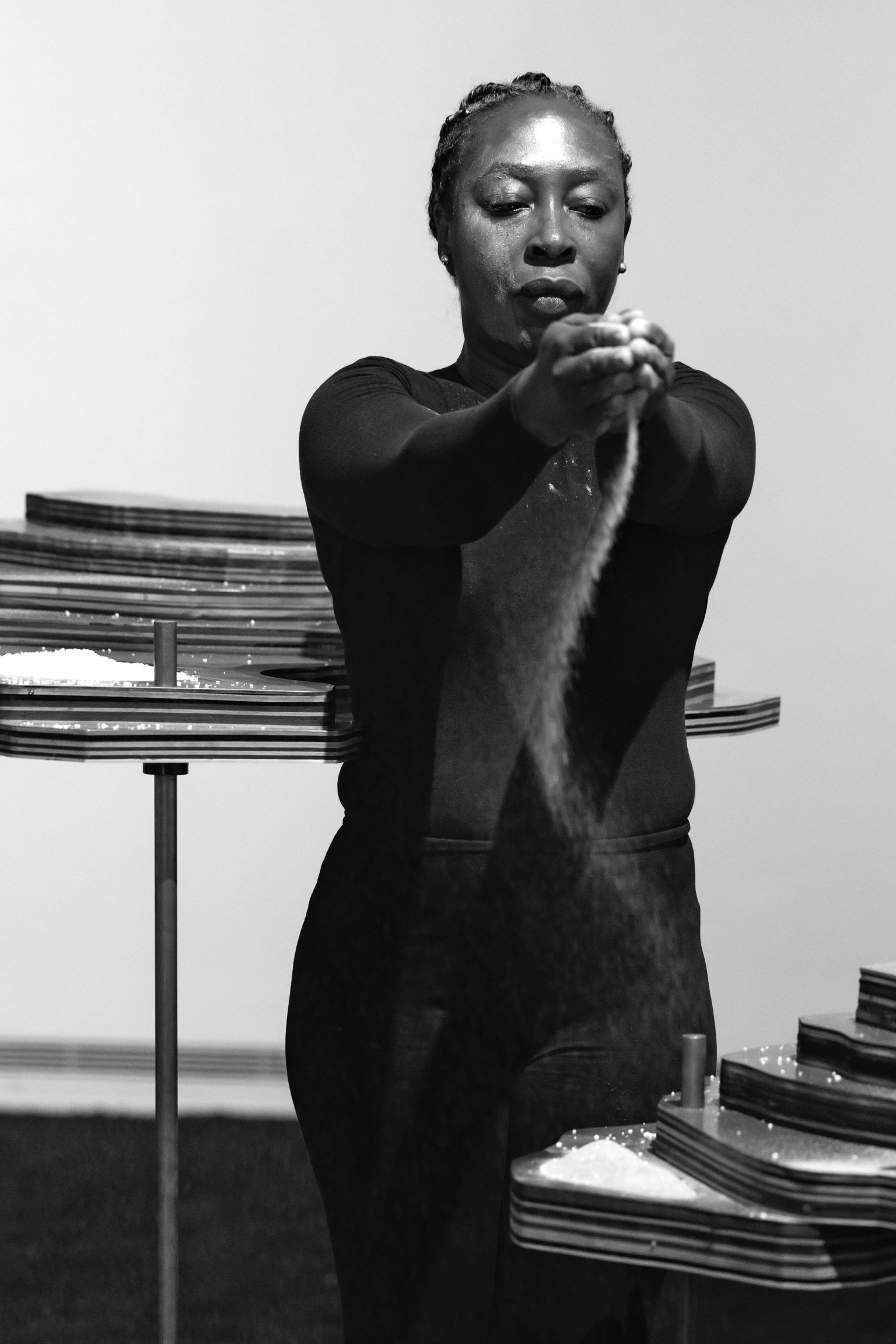
In this gallery, the installation Solid Maneuvers (2015) presents a more abstract view of the scarred lands from which resources are extracted. In keeping with the works on Tsumeb displayed in Gallery 2, it recreates a stratified topography of a hollowed out mine using the mined minerals that have been transformed and altered. As the artist points out, ‘Instead of building a new monument to commemorate the absence or the act of emptying, I asked: Could the emptied space be the monument?’ Solid Maneuvers is thus the poetic translation of the inverted and excavated topography of ‘Green Hill’, a name that goes back to a time when the site’s mineral-rich slopes shone with a green oxidised copper. The installation contains salt, cosmetics, heavy mineral sands, and copper and serves as a poignant reminder of the ecological implications of capitalist accumulation. The dimensions of the sculptures are based on human body measurements, thus referring to the question of the body as a necessary tool in mining operations.
In performances that involve her entire body, the artist stands amid the sculpture elements and makes a series of repetitive and mechanical gestures, borrowing from the worlds of industrial work and mining. Handling raw materials while making automated gestures, counting, and reciting fragments of stories, she physically portrays the way human beings through their movements mould and shape nature and mark landscapes.
This gallery also features several series of drawings, including Pointe-Noire, which the artist made in 2009 during a residency at the Centre culturel français du Congo in Pointe-Noire (Republic of the Congo). These drawings evoke the environmental degradations that are due to extractive and oil drilling operations. Nkanga blends dismantled landscapes, dislocated limbs, and industrial elements connected to the local geography, mapping in this way the history of Pointe-Noire.
2nd Floor
Unearthed
The second-floor space opens on four monumental tapestries displayed in a row. The medium is central to the artist’s work and is part of a dual legacy for Nkanga, that of West Africa, where tapestries are a way of communicating a message or a story; and Flemish landscape tapestries, which enabled rich families to tell their story and show off their view of the world.
Nkanga creates contemporary landscapes that expand and shift these viewpoints while bringing to light what had once been concealed. With the four tapestries that make up Unearthed (2021), originally designed for the four floors of Kunsthaus Bregenz, she spins a tale that begins in the great ocean depths (Abyss), ascends to the light of a sunny landscape (Sunlight), passing through shallower waters (Midnight) and where the sea meetsthe shore (Twilight). Here the artist connects stories of deep mining exploitation to climate change, linking visible and invisible worlds. She also evokes the triangular trade and the millions of lives lost by depicting body parts washed ashore, transformed into mineral forms containing the very substances that sustain today’s technologies.
From one tapestry to the next the eye can follow a vertical orange line that begins in Abyss and rises up to Midnight and finally Twilight, in each case crossing a different constellation of minerals. We also notice increasing numbers of jellyfish, an indication that ocean temperatures are rising. The colour is shifting slowly to-wards a warmer tone, and once the line arrives at Sunlight it melts away into the landscape. In the latter, pockets of hardy plants used at gravesites have been inserted into the tapestry, ivy, ferns, and heather. As the artist remarks, ‘It’s a way of saying that within all that loss, other things survive, which have survived other catastrophes over time. That’s the whole idea of the Unearthed series.’
Spaces of restoration
At the centre of the exhibition space a network of carpets is laid out on the floor, their horizontality presenting a clear contrast with the verticality of the tapestries. The carpets draw their form from the magnified structures of rocks and minerals: quartz for Leaving trails in the distance (2021), malachite and azurite for Lined with shivers sprouting from the rock (2021), and pyrargyrite for We Come from Fire and Return to Fire (2024). The hand-dyed wool is tufted to give the surfaces volume and texture, emphasizing their three-dimensionality.
The carpets are accompanied by sculptural elements: beech wood with carved receptacles, glass containers reminiscent of pods, and ceramic balls and hexagons linked by hand-woven ropes. Together, they reveal a vast network that reflects the intermingling of landscapes and continents. Nkanga imagines the carpet-rocks as sites of softness, spaces for restoration and respite, where the senses are heightened. Along these lines, the installation also includes olfactory elements made from organic materials such as medicinal plants and drops of essential oils. Two ceramic spheres diffuse the artist’s overlapping voices, merging singing and whispering into the environment.
In recent years, Nkanga has renewed her interest in ceramics, which had been present in her work from the outset. Here, it takes the form of sculptures installed throughout the space, and clay plaques engraved with poems that create a visual rhythm on the walls.
Akin to burnt trees, the abstract stone-ware columns of the Beacon series (2024) rise up toward the sky, their cracked and blackened aspect recalling the fragility of ecosystems. Arranged around the columns, containers hold dried seeds underscoring the vulnerability of plant life and our food systems.
Carved to Flow
The question of circulation – of resources and people, across multiple geographies and through time – appears in various forms throughout the artist’s work. It is seen, for example, in the tapestries of the Unearthed series, but also in a more abstract way in the collaborative project Carved to Flow, elements of which are presented here.
Begun by Nkanga in 2017 as part of documenta 14 in both Kassel, Germany, and Athens, Greece, Carved to Flow exists at the intersection of art and the social sphere. In Athens, Nkanga relied on the expertise of the Greek soap-maker Evi Lachana to create bars of soap, including her 08 Blackstone Soap – a cold-production process soap comprising water, coal, lye and seven butters and oils from the Mediterranean, the Middle East, North and West Africa.
Thanks to the proceeds from the soap sales, the artist has set up two initiatives. One is an art space in Athens called Akwa Ibom co-founded with Maya Tounta. The other is a foundation, an organic farm in Nigeria whose products are sold at a low price and where local residents can come for water. As the artist notes, ‘It’s a reflection on how to generate an economy, but not an economy of greed. An economy of sustaining and maintaining, an economy that helps to regenerate things.’ In 2025 two new bars of soap 08 Salt Rock and 08 Red Bond were launched by Nkanga. She worked closely with the Austin soap-maker Emlyn Roesler who sourced the raw materials in North Texas in the United States.
On the second-floor, the show opens and ends with Soft Offerings (2022), a piece meant to be activated by a pair of bearers distributing offerings and flowers or chanting, a way to pay homage to all forms of nonhuman life – stone, wind, ants, birds, water, plants – inviting us to imagine the interconnectedness of humans and the natural world.
The artist’s quotations come from the following publications:
- ‘Otobong Nkanga in conversation with Odile Burluraux and Nicole Schweizer’, Otobong Nkanga. I dreamt of you in colours, Paris, éditions Paris Musées, 2025, p. 29–48.
- ‘Intricate Connections. Otobong Nkanga, Clare Molloy & Fabian Schöneich’, Otobong Nkanga. Luster and Lucre, Berlin, Sternberg Press, 2017, p. 165–187.
Biography
Born in Kano, Nigeria in 1974, and now living in Antwerp, Belgium, and Uyo, Nigeria, Otobong Nkanga trained at Obafemi Awolowo University in Ilé-If, Nigeria, the École Nationale Supérieure des Beaux-Arts in Paris and the Rijksakademie in Amsterdam.
Her work has been featured in many solo exhibitions, including: Nasher Sculpture Center, Dallas (2025); The Museum of Modern Art, New York (2024); Instituto Valenciano de Arte Moderno – Centro Julio Gonzalez, Valencia, Spain (2023); Frist Art Museum, Nashville, United States (2023); Museum Sint-Janshospitaal, Bruges, Belgium (2022); Kunsthaus Bregenz, Austria (2021–2022); Castello di Rivoli Museo d’Arte Contemporanea, Rivoli, Turin, Italy (2021–2022); Villa Arson, Nice, France (2021); Henie Onstad Kunstsenter, Hovikodden, Norway (2020–2021); Martin-Gropius-Bau, Berlin (2020); Middlesbrough Institute of Modern Art, United Kingdom (2020–2021); Zeitz Museum of Contemporary Art Africa, Cape Town (2019); Tate St Ives, United Kingdom (2019); Museum of Contemporary Art Chicago (2018); Tate Modern, London (2017); Museum Folkwang, Essen, Germany (2015); Stedelijk Museum Schiedam, Netherlands (2015); Portikus, Frankfurt am Main, Germany (2015); Museum of Contemporary Art Antwerp (2015); Kadist, Paris (2015).
The group exhibitions in which she has participated include the biennials in Venice (2026 and 2019), São Paulo (2025), Lyon (2024), and Sharjah (2019), as well as documenta 14 (Athens and Kassel, 2017).
Otobong Nkanga received the Jury’s Special Mention Award at the 58th Venice Biennale (2019). She is the recipient of the Finkenwerder Art Prize (2026), the Zeitz MOCAA Honorary Award for Artistic Excellence (2025), the Nasher Prize for Sculpture (2025), the Golden Afro Artistic Award (2024), an Honorary Doctorate of the University of Antwerp (2024), the Peter-Weiss-Preis, Bochum (2019), the Sharjah Biennale Prize (2019), the Lise Wilhelmsen Art Award (2019), the Ultima Flemish Cultural Prize for the Visual Arts (2018), the Belgian Art Prize (2017) and the Yanghyun Prize (2015).